Part five of five in The Modern Technology Organization, a series from Paragon by Riviera Partners, the talent partner that helps top and growing technology companies scale, structure, and transform their teams. This series draws on our ebook, The Modern Technology Organization: How to Hire and Structure Teams for Today’s Org Design Models.
What we learned that works
- Deploy your strongest leaders where complexity is highest—the cross-team seams with the greatest cost of misalignment.
- In autonomous orgs alignment is created, not enforced; it’s ongoing, invisible work that standard reviews under-reward.
- Distributed teams need explicit operating discipline: defined decision rights, information flow, and rhythms that don’t rely on proximity.
- Start where the strain is greatest—diagnose hiring throughput, decision-making, team interplay, and leadership deployment.
The first four pieces in this series described one problem from several angles. Modern tech companies flattened, distributed, and empowered themselves into a state where they feel fast and struggle to turn that speed into aligned results, which is the execution gap. and into the seams between autonomous teams. Meeting that demand takes hiring for judgment and adaptability and treating hiring as a scaling lever rather than a support function.
This piece is about what you build once you accept all of that, because getting the diagnosis right only helps if you know what to put in its place. Modern org design raises the bar on how you lead, staff, and operate a company, and a leadership team has to get four things right for these models to work. The first is hiring, covered in the two previous pieces. The other three are the subject here.
Put your best leaders where it hurts most
Flattening cuts the number of leadership layers while raising the need for leadership. That sounds like a contradiction until you look at where the work went. It did not disappear with the layers. It spread across a structure with fewer people left to do it. So the answer is not to add layers back. It is to get far more deliberate about where you place the leaders you have.
The instinct most companies follow is to stack their strongest leaders at the top, or to spread them evenly so every team gets a share. Both are wrong for a flat, networked organization. The right move is to deploy your best people where the complexity is highest: the areas with the most cross-team dependencies and the steepest cost of misalignment. That is where a strong leader prevents the most damage and creates the most leverage, and where a weak one does the most harm.
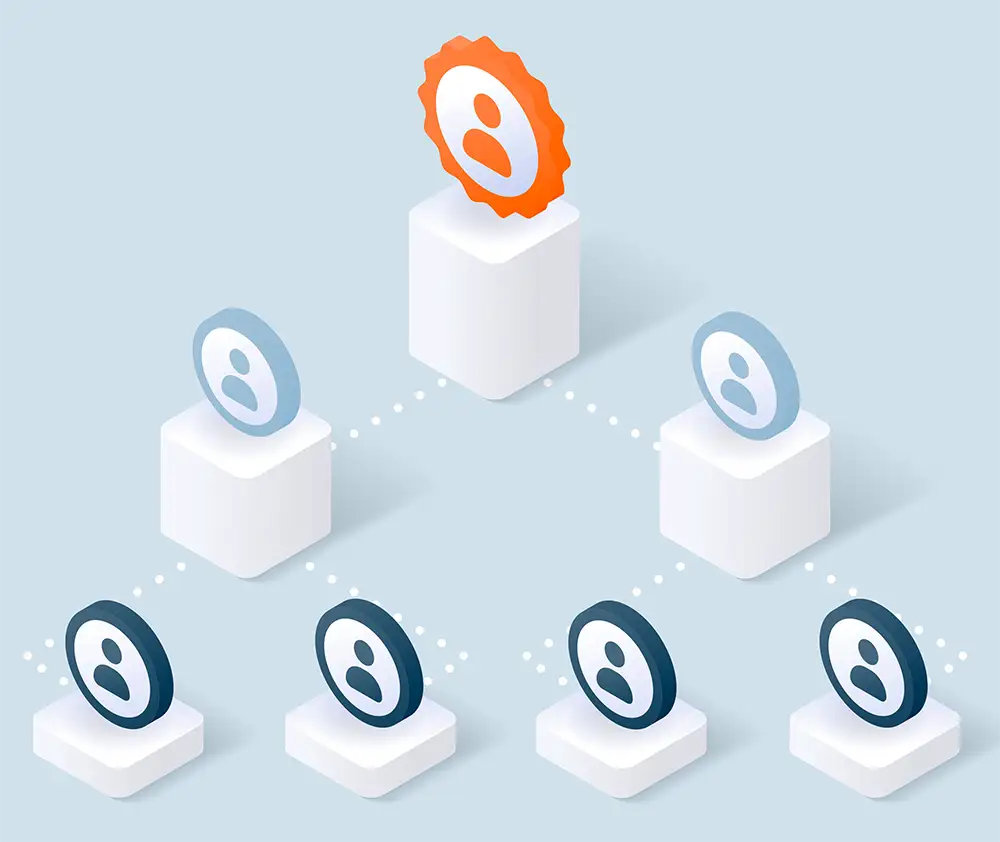
Leadership density means leadership exists throughout the company rather than clustered at the top. Without it, a flat structure turns fragile, with too much responsibility resting on too few people, one departure or one overloaded quarter away from coming apart.
Hiring and evaluating for density looks different from traditional leadership assessment. Team size and scope of ownership, the old proxies, predict little here. What predicts success is a leader’s track record of moving decisions across functions, managing competing priorities, and holding alignment in a shifting environment. You may also need to rethink how you measure and reward these leaders, because their impact happens across teams rather than inside one domain. Judge a leader on their team’s output and on their ability to drive alignment, unblock others, and contribute to outcomes beyond their own patch. If your incentives only reward local results, you will get local optimization, and that is the exact failure a networked organization cannot afford.
Alignment is a job, not a byproduct
In a flat, autonomous organization, alignment becomes ongoing work that leaders perform rather than a state the structure guarantees. In a hierarchy the org chart itself decides who defers to whom and whose priorities win. A network-of-teams organization gives that up. Once teams are autonomous, no one can impose alignment from above. Leaders have to create and maintain it continuously from within.
That turns alignment from a state the structure guarantees into an activity leaders perform. Effective leaders in these environments keep reinforcing priorities, clarifying tradeoffs, and making sure a decision in one corner of the company does not quietly create a problem in another. They connect roadmaps across teams, surface conflicts before they escalate, and help others move faster because the shared picture is genuinely shared. This is ongoing work, not a quarterly planning ritual, and it is most of what keeps autonomous teams pointed the same way.
It also changes who you promote into these roles. Favor people comfortable operating beyond their own scope, leaders who can move decisions without formal authority over them, because in a network that is the only kind of influence on offer. The best of them understand not just what their team owns but how that work fits the whole system, and they adjust accordingly.
One thing makes this hard to manage: in autonomous environments, effective alignment work is nearly invisible. When a leader defuses a conflict before it becomes a fire, nothing appears to happen. That invisibility keeps it out of standard performance reviews, so you have to go looking for it. When you evaluate leaders, look past their team’s execution and ask how well they reduce friction across teams, resolve tradeoffs early, and contribute to shared outcomes. Miss this and you will systematically underpay the exact behavior your organization most depends on.
Distributed work needs an operating system
Distributed teams stay coordinated only through explicit operating discipline: defined decision rights, clear information flow, and rhythms that do not depend on being in the same room. Hybrid and remote work make this the operating system underneath everything else. In an office, a lot of coordination happens by accident: decisions made in hallway conversations, ambiguities cleared up in a quick face-to-face. Spread the company across locations and time zones and that informal layer evaporates. Everything turns into an email, a message, an async thread.
When that is the medium, the failures are predictable. Decisions stall while teams wait on input across time zones. Communication fragments across tools and channels. Teams work from different context and assumptions, so alignment erodes without anyone choosing to let it. Culture gets harder to sustain without the proximity that used to reinforce it.
The answer is deliberate operating discipline. A distributed company has to define, out loud, how decisions get made, how information moves, and how teams stay aligned, all the things a co-located company could leave unspoken. Leaders then have to reinforce those behaviors consistently, so teams know how to operate without someone in the next room. As organizations spread out, they lean harder on explicit systems for decision-making, information flow, and alignment. The most effective leaders in these settings make expectations explicit, communicate decisions in a form other people can act on, and set rhythms that keep teams aligned without relying on being in the same place.
Where to start
Shifting toward a flatter, more autonomous, more distributed organization is not something you do all at once, and you are almost certainly operating this way to some degree already. The most effective approach is to find where your organization is under the most strain and start there. Four diagnostics point the way.
Look at your hiring throughput and quality. How fast can you find and onboard high-judgment people into critical roles, and where are hiring gaps choking execution right now?
Look at how decisions actually get made. Where do they slow down, get escalated when they should not, or get reopened again and again? Those are the places alignment is failing.
Look at how teams operate relative to one another. Where do dependencies create friction, and where are teams moving fast while producing inconsistent outcomes? That inconsistency is the fingerprint of autonomy without shared context.
Look at how your leadership is deployed. Are your most experienced leaders sitting in the areas of highest complexity and impact, or somewhere more comfortable and less consequential?
The answers tell you where to begin. You do not have to fix everything at once, and trying to will spread you too thin to fix anything. Start where the strain is worst.
The through-line
Everything in this series comes back to one idea. As a company moves away from centralized control toward distributed decision-making, performance stops being a product of structure and becomes a product of the quality of leadership and talent across the whole system. The org chart cannot save you. The people making decisions inside it, and the systems that keep those decisions aligned, are what determine whether ambition turns into execution.
The organizations that get it right do four things well. They put leadership density where it matters most. They treat alignment as active work rather than a structural given. They treat hiring as a core scaling lever. And they build the operating discipline that lets distributed teams execute with consistency. None of it is free, and none of it is automatic. Together, it is what turns a fast-feeling company into one that is actually going somewhere.
Frequently asked questions
What is leadership density?
Leadership density means capable leadership exists throughout the organization rather than concentrated at the top. In flat structures with fewer layers, it is the deliberate placement of strong leaders where complexity is highest, so that responsibility isn’t dangerously concentrated in too few people.
How do distributed teams stay aligned without hierarchy?
Alignment becomes an active, ongoing leadership responsibility rather than something the structure enforces. Leaders continuously reinforce priorities, clarify tradeoffs, and connect roadmaps across teams to resolve conflicts before they escalate. Because this work is largely invisible, organizations have to evaluate and reward it deliberately.
Where should an organization start modernizing its structure?
Start where the strain is greatest. Diagnose four areas: hiring throughput and quality, how decisions actually get made, how teams affect one another, and where your strongest leaders are deployed. Address the highest-strain area first rather than attempting to change everything at once.
Previous: Part 4
About this series: This article and the accompanying ebook, The Modern Technology Organization: How to Hire and Structure Teams for Today’s Org Design Models, were developed by Paragon by Riviera Partners , a leader in helping top and growing technology companies hire, scale, and structure their teams. Drawing on our work with hundreds of technology organizations, Paragon partners with CEOs and HR leaders to identify, evaluate, and place the leaders and talent who can scale decision-making, maintain alignment across teams, and turn ambition into execution. Download the full ebook or learn more about Paragon.